

I spent this year listening.
Hallway conversations at conferences. Zoom calls that ran long. Coffee that turned into strategy sessions. Cocktail conversations that got more honest with each round. I have had the privilege of hearing this industry think out loud from every seat it has - ownership groups, operators, department leaders, site teams, PropTech founders, service providers, venture partners.
Different seats. Different stakes. Different vocabularies. And every one of those conversations, sooner or later, landed on the same word.
Stuck.
Not failing. Stuck. The distinction matters. Failing organizations know they are failing. Stuck organizations are working harder than ever, running initiative after initiative, buying tool after tool - and ending the year in roughly the same place they started, with a slightly worse margin.
For a long time I collected these conversations as separate problems. A data problem here. A staffing problem there. A technology problem, a trust problem, a budget problem. Then, somewhere around the fortieth conversation, the dots connected, and I stopped seeing a list.
These are not fifteen problems. They are one system.
Each constraint holds the others in place. That is why the point solutions have not worked. That is why the transformation decks gather dust. The industry is not stuck because of any one failure. It is stuck because its failures interlock.
I call it The Interlock™. Here is the whole system, one lock at a time - and then the mechanism that binds them, and the one window this year when you can actually do something about it.
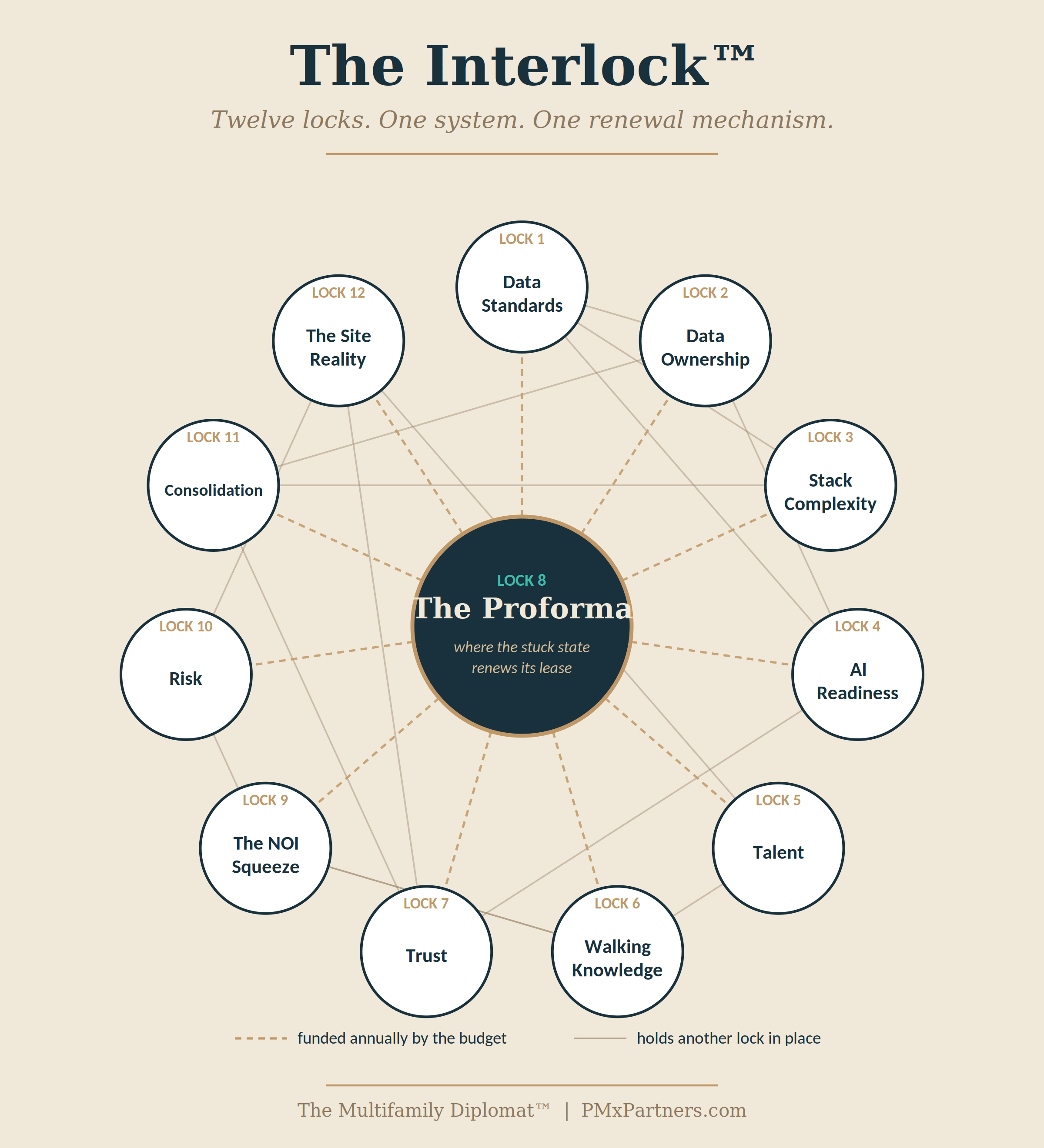
The Twelve Locks
Lock 1: Data Standards
Two asset managers at the same table, comparing the same market, could not agree on what “occupancy” meant. Their systems count it differently. Both were right.
The industry runs on data with no shared language. Every operator defines the same metric a slightly different way, every system exports it in a different shape, and every acquisition means months of translation. Without standards, benchmarking is theater and AI is guesswork. The cost hides in plain sight: every report reconciled by hand, every integration a custom build, every decision made on numbers nobody fully trusts.
Lock 2: Data Ownership
An executive discovered at renewal that a decade of her organization’s operating history lived in a vendor database. The contract was silent on whether she could take it with her.
Ownership is the foundation under standards, and most operators never poured it. Data rights sit buried in agreements written years ago, discovered only at renewal or in diligence. An organization that does not own its operating history cannot switch systems freely, cannot train models on its own patterns, and negotiates every renewal from weakness. This lock turns every technology decision into a hostage negotiation.
Lock 3: Stack Complexity
I asked a COO to count the systems her site teams touch in a day. She passed twenty before the coffee arrived.
The stack got out of control one reasonable decision at a time. Each tool solved a real problem. Together they created a new one: overlapping functions, orphaned licenses, integrations held together by exports and goodwill, site teams toggling between screens while a resident waits. Nobody can untangle it because nobody owns the whole picture - and every consolidation-driven migration scrambles it again.
Lock 4: AI Readiness
The same executive team, in the same hour, told me AI was their top priority and gave me four reasons they could not start.
AI is ready and waiting. The organization is not - and not for technical reasons. The blockers are propaganda and fear. Fear of regulation that has not arrived. Fear of job losses that leadership has not addressed honestly. Fear that whatever ships will be outdated the moment it does. Meanwhile the data it would run on is unstandardized and unowned. AI does not fail in real estate for lack of capability. It fails for lack of foundation and lack of a workforce story.
Lock 5: Talent
Ask a room of senior operators how they got into this industry. Nearly every answer starts the same way: “I fell into it.”
Real estate is a fall-back career competing for people who have choices. There is no visible path from the leasing desk to the executive floor, so the industry cannot attract top talent as a first choice and cannot keep the talent it finds. Staffing shortages press on every function, and the roles the future actually requires - data, AI operations, experience design - do not exist on most org charts. The pipeline problem is a positioning problem. The industry has never sold itself as a destination.
Lock 6: Walking Knowledge
A regional with twenty years of pattern recognition took a package in an efficiency play. Six months later, three of her former properties were in trouble nobody saw coming. She was the early-warning system.
Efficiency plays optimized the cost line and quietly liquidated the knowledge base. The operators who carry the deep tribal knowledge - what I call Deepertise™: how to read a property, when a number is lying, how to steady a team - are walking out the door, and nothing captures what they know. Mentorship thins. Judgment thins. Mistakes that experienced eyes would have caught now reach the P&L. And at the top of the house, an aging leadership generation with no succession plan is the same lock at executive scale. The industry is spending millions to save thousands.
Lock 7: Trust
A site team heard the word “rollout” and visibly braced. That reflex was trained.
Every failed implementation left a residue. The field has learned that new systems mean more work, less support, and a quiet retreat eighteen months later. Change management gets treated as a training calendar instead of an organizational discipline, and half-finished centralization moved boxes on the org chart without moving trust or workflow. So the next initiative - even the right one - starts in a credibility deficit it did not earn.
Lock 8: The Proforma
I read a 2027 draft budget this month that was the 2026 budget with a three percent escalator. It had been reviewed, approved, and was headed to the field as strategy.
Business proformas as usual are the mechanism by which the stuck state renews its lease. The budget is where transformation either gets funded or gets deferred, and in most organizations it is built by copying forward: same headcount model, same stack, same assumptions, same quiet acceptance of last year’s leakage. No audit. No sponsored redesign. No line item for the future state. The organization plans to be next year exactly what it was this year - and then wonders why it is.
Lock 9: The NOI Squeeze
A CFO walked me through the bridge from budget to actuals. Every variance was small. The sum was not.
Cost creep on every line - insurance, payroll, turns, technology - meets rent stagnation driven by the supply wave in the growth markets. The squeeze narrows the margin for error and, cruelly, funds the other locks: when NOI compresses, organizations cut the deep expertise, defer the data foundation, and press the site teams harder. Layer on loan maturities, refinancing pressure, and exit-cap uncertainty, and hold periods shorten - which starves exactly the multi-year investments that would break the cycle.
Lock 10: Risk
A fraud ring worked a leasing workflow better than the newest member of the leasing team could. That is not an anecdote. That is an arms race.
Fraud is growing in sophistication faster than defenses are, and the total cost of risk - premiums, deductibles, claims, compliance - has become one of the largest and least-managed drains on NOI in the business. Add a regulatory patchwork on fees, screening, and pricing that shifts market by market, and risk stops being an insurance line and becomes an operating discipline most organizations have not built. The organizations treating risk as a procurement exercise are subsidizing the ones treating it as intelligence.
Lock 11: Consolidation
The week the acquisition was announced, the acquired company’s two best regionals started returning recruiter calls.
Consolidation is running on both sides of the industry at once. Owner-operators merge, and the acquired organization’s knowledge, culture, and customer relationships get treated as integration line items. PropTech vendors consolidate, and roadmaps stall, support thins, contracts get repapered, and the data ownership question resurfaces with a new counterparty. Each wave deepens the mistrust - staff wondering how they will be treated, customers wondering whether the product they bought still exists - and scrambles the stack and the standards yet again.
Lock 12: The Site Reality
One community manager’s Tuesday: four systems, two callouts, one flooded unit, eleven unanswered leads - and a resident review that mentioned none of the heroics.
Resident expectations have moved to a hospitality model. The staffing model has not moved with them. Site teams firefight all day inside a role design built for a different decade, turnover recycles the same positions, and the experience gap gets papered over with amenities instead of redesigned service. This is the lock every other lock lands on. The site level is where data problems, stack sprawl, trust deficits, and staffing shortages stop being abstractions and become a resident’s bad day - and a renewal that does not happen.
The Interlock™
Read the twelve again and notice something. Every lock, taken alone, has a known solution. The industry is full of capable vendors, smart frameworks, and conference sessions solving locks one at a time. Most of them are not wrong.
They fail anyway, because every lock is held in place by at least two others.
You cannot fix staffing without career paths - and you cannot build career paths while efficiency plays push your Deepertise™ out the door. You cannot deploy AI on data you do not own or standardize - and you cannot standardize across a stack that consolidation keeps scrambling. You cannot earn trust for the next rollout when the last three burned it - and you cannot rebuild trust without a change discipline the organization never developed. You cannot fund any of it while cost creep and rent stagnation compress NOI - and the proforma-as-usual guarantees the compression continues.
Pull on any single lock and the system pulls back. This is why the point solution era failed. Every vendor sold a key to one lock while eleven others held. The tools were real. The system was stronger.
And at the center of the ring sits the budget. The proforma is the renewal mechanism - the annual ceremony in which the organization signs another twelve-month lease on its current constraints. Whatever the budget funds, the organization becomes. A budget built by copying forward funds every lock exactly as it stands.
This is where the two worlds I have been writing about all year actually separate. World One organizations attack the system with a sequence. World Two organizations keep buying keys to individual locks. The gap between them compounds annually.
And the compounding event is happening right now.
The Window
If you lead an owner-operator organization, you are deep in 2027 planning at this moment. In September, the budget rolls out to the field and the site level. At that moment, the numbers stop being assumptions and start being instructions.
That gives you a clock. There is a six-to-eight week window - this window - in which the 2027 plan can still be audited, challenged, and redesigned. A window in which optimization value can land as line items that move in this cycle, not recommendations for next year. A window in which the future state can be funded instead of laminated.
After the rollout, the same insight costs you a year of waiting or a mid-year budget fight. Every executive knows which of those is worse.
So here is the question this paper exists to ask, and it deserves an honest answer: who in your organization is auditing the 2027 plan before it rolls to the field?
Not reviewing it. Auditing it - against where you actually intend the organization to be in two to three years. In most shops the honest answer is nobody, because everyone senior enough to do it is buried in producing it.
Your 2027 budget will either fund the shift or fund the stuck state. It will not do neither.
What Comes Next
That is the diagnosis, and the clock. What follows below is the method: the three principles of getting unstuck, what a thoughtful-redesign proforma changes that a three percent escalator never will, the audit questions to ask before 2027 sign-off, where the money is hiding in a budget your size, and the diagnostic that maps your organization against all twelve locks.
The insight above is free, and it always will be - that is the standing promise of this publication. The playbook below is for the executives who intend to use it before September.
